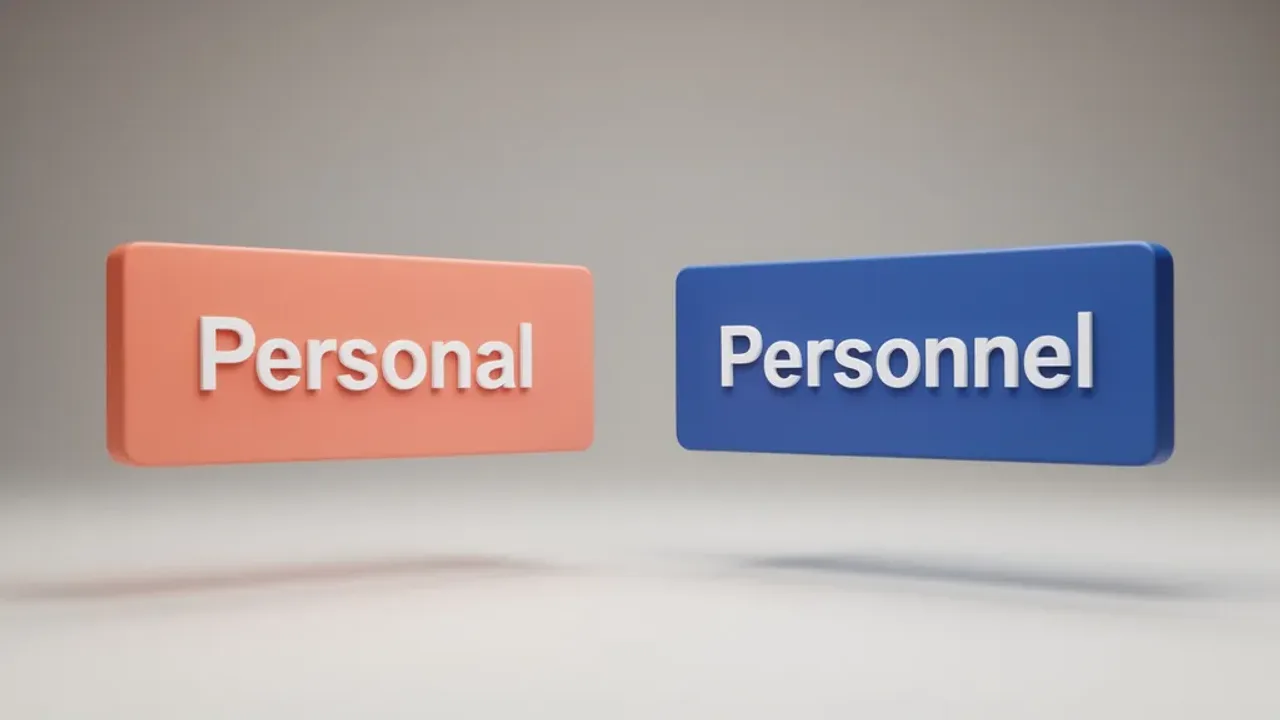
The primary difference between these terms is that "personal" describes something individual or private, whereas "personnel" functions as a collective noun for employees within an organization. Distinguishing between personal vs personnel is essential for maintaining clarity in both professional and daily communication. While the two words share a common linguistic root, their usage, spelling, and grammatical functions are distinct. Understanding these differences allows writers to avoid common errors that often arise in corporate and casual correspondence.
SpellingSeptember 4, 2026
Personal vs. Personnel: What Is the Difference?
 AI-generated image
Key Takeaways:
- Personal refers to individual or private matters, while personnel refers to staff.
- Personnel is a collective noun often used in professional or organizational contexts.
- Use the double "n" in personnel to help distinguish it from the singular nature of personal.
- These terms are distinct in both meaning and grammatical function.
| Feature | Personal | Personnel |
|---|---|---|
| Primary Meaning | Private or individual | Workforce or staff |
| Part of Speech | Adjective | Collective noun |
| Common Usage | Personal belongings | Personnel department |
| Spelling Tip | Single "n" | Double "n" |
Defining the Term Personal
The word "personal" is primarily used as an adjective. It describes anything that relates to a specific person or belongs to an individual. When you use this term, you are focusing on the private or individual aspect of a subject. For instance, you might refer to "personal belongings," which are items owned by an individual rather than an organization. Similarly, a "personal matter" is something that concerns a single person and is not intended for public or professional discussion.
Because "personal" is an adjective, it typically precedes a noun. It characterizes the nature of that noun. Whether you are discussing personal growth, personal space, or personal preferences, the focus remains on the singular, private domain. It is vital to recognize this focus when choosing your words, as it sets the tone for your message. Using "personal" correctly helps maintain boundaries between individual life and professional responsibilities.
Defining the Term Personnel
"Personnel" occupies a different role in the English language. It acts as a collective noun, referring to the entire group of people employed by a company, institution, or government body. When you speak about the personnel of a business, you are discussing the staff as a whole rather than focusing on any single employee. This term is most commonly encountered in administrative or human resources contexts.
Unlike "personal," "personnel" does not typically function as an adjective. You would not describe an item as being "personnel." Instead, you might refer to the "personnel department," where the word acts as a modifier for the department that manages the staff. This collective noun is treated as a plural concept in most cases, yet it does not require an "s" to indicate plurality. It inherently represents a group of individuals working within a common structure.
When to Use Which
Choosing between these terms requires analyzing your intent. If you are describing items, beliefs, or issues that belong to a single human being, "personal" is the correct choice. It is the word for individual privacy. In contrast, "personnel" is the correct choice when referring to the collective staff of an organization. If you are discussing the workforce or human resources, "personnel" is the appropriate term. Selecting the right word when considering personal vs personnel prevents confusion between individual privacy and organizational staffing matters.
- Assess the context: Are you talking about one person or a group?
- Identify the grammatical role: Do you need an adjective or a collective noun?
- Use "personal" for private items or individual opinions.
- Use "personnel" for the staff of a company or organization.
- Always verify the spelling to ensure the double "n" is present for "personnel."
Causes of Usage Confusion
The confusion between these two terms arises primarily because they share the same linguistic root and similar phonetic structures. Because both words begin with the same sequence of letters, writers often misspell "personnel" by mistakenly using a single "n" to mirror the spelling of "personal." This is a common orthographic error. Recognizing the double "n" in "personnel" as a marker for a plural group of employees helps distinguish it from the singular, private nature of "personal." A firm grasp of personal vs personnel is fundamental to achieving accuracy in written work. Accuracy builds trust.
Frequently Asked Questions
Is the word personnel plural?
Yes, "personnel" is a collective noun that represents a group of people employed by an organization. It is treated as a plural entity when referring to the staff as a whole, even though it does not take an "s" at the end.
Can personal be used to describe staff?
No, "personal" should not be used to describe staff members or employees. Using "personal" in that context is incorrect; the term personnel is specifically reserved for identifying the workforce or staff members of an organization.
How can I remember the difference?
A helpful trick is to associate the double "n" in "personnel" with the idea of many people working together. Conversely, "personal" contains only one "n," which can be linked to the concept of one individual person or private matters.
When should I use these terms in an email?
Use "personal" when writing about your private life or individual tasks. Use "personnel" when writing to or about the HR department or the entire staff of your company.
Are there exceptions to these definitions?
In standard English, these definitions are quite stable. "Personal" remains an adjective for individuals, while "personnel" remains a collective noun for employees. Following these rules ensures professional clarity in all forms of writing.
To use these words correctly, remember that "personal" denotes individual privacy while "personnel" refers to the collective group of employees. Always check the spelling to ensure you include the double "n" when referring to organizational staff.
Share: