The correct spelling is "occurred," which is spelled with double "r." The version spelled with a single "r," "occured," is incorrect.
SpellingNovember 14, 2026
Occurred: The Correct Spelling of the Past Tense of Occur
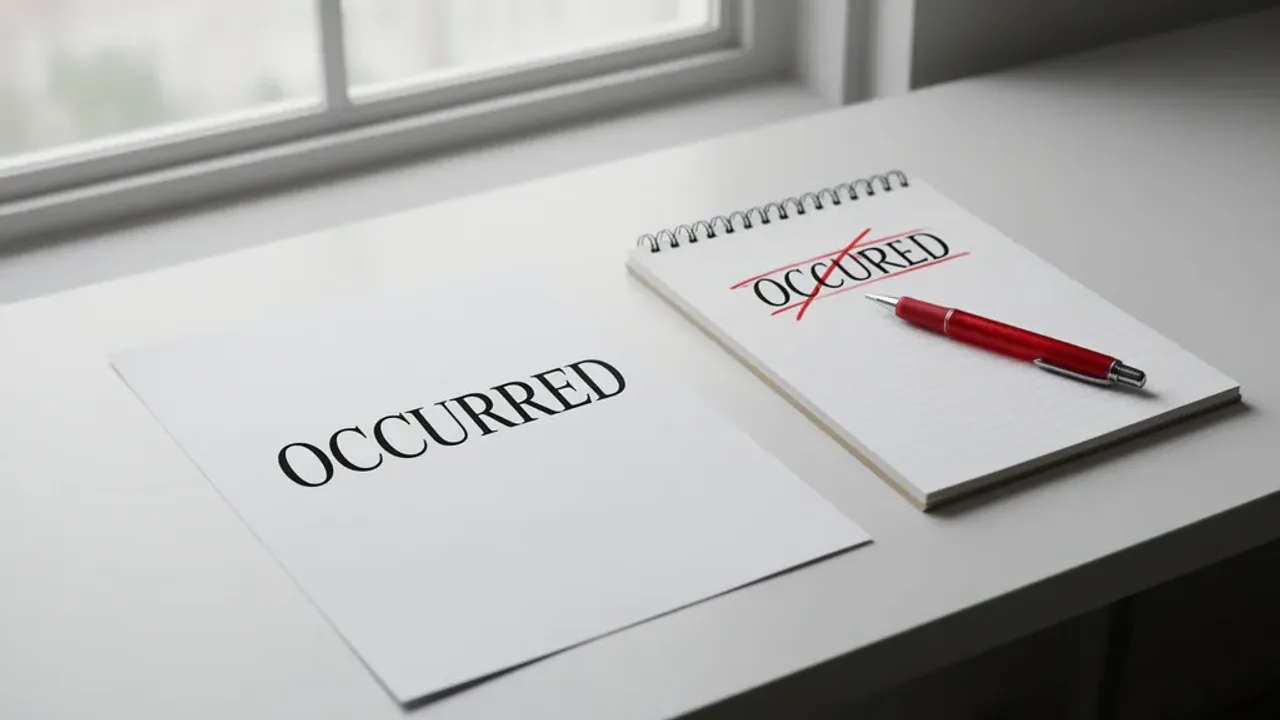 AI-generated image
Key Takeaways:
- The correct past tense of the verb "occur" is occurred.
- "Occured" is a misspelling and is never acceptable in formal writing.
- The double "r" is required because the stress falls on the final syllable of the root word.
- Consistency in your writing is maintained by following standard spelling rules for consonant doubling.
Many writers search for occured or occurred to clarify proper usage. Proper spelling is vital for professional communication. "Occurred" is the only valid past tense form of the verb "occur." Any variation omitting the second "r" is a typographical error. This mistake can negatively impact the professional tone of your written work. It is essential to recognize the correct form to maintain high standards in your documents, emails, and reports.
| Form | Spelling | Status |
|---|---|---|
| Correct | Occurred | Standard |
| Incorrect | Occured | Typo |
Understanding the Rule Behind the Spelling
To understand why the word is spelled with two "r"s, one must look at the rules of English orthography regarding suffix addition. When a root word ends in a consonant-vowel-consonant (CVC) pattern, and the final syllable is stressed, the final consonant must be doubled before adding a suffix such as "-ed" or "-ing."
In the case of "occur," the word ends in "r" preceded by a single vowel "u." Because the stress falls on the final syllable, doubling the "r" becomes mandatory. This rule is not unique to this specific word. It applies to many other verbs in the English language, such as "refer" becoming "referred" or "transfer" becoming "transferred."
When you encounter the dilemma of occured or occurred, you are essentially testing your knowledge of these fundamental linguistic patterns. Many people mistakenly assume that a single "r" is sufficient, perhaps because they are familiar with words that do not follow this rule. However, ignoring the double consonant rule leads to common errors that are easily avoided once the logic is understood.
When to Use Which
Use "occurred" whenever you need to indicate that an event happened or took place. This is the only valid past tense version. Avoid using "occured" in any document. It will be flagged as a misspelling by virtually every modern word processor. Always check your spelling before finalizing a text.
- Verify the spelling by double-checking for the double "r" before sending any important correspondence.
- Memorize the consonant-vowel-consonant pattern to ensure future accuracy in your writing.
- Use reliable spell-check tools to catch accidental omissions during the drafting process.
- Review your work carefully, as typos can often slip through even with digital assistance.
Consistent spelling is a hallmark of clear communication. By adhering to these steps, you ensure that your writing remains professional. Accuracy matters.
Where the Confusion Comes From
The mistake of writing "occured" stems from a misunderstanding of suffix rules. Many writers forget that when a word ends in a single consonant preceded by a single vowel, the final consonant must be doubled. Because the stress in "occur" lands on the final syllable, the "r" requires doubling. It is a strict requirement of English grammar. Failure to apply this rule results in a word that does not exist in standard dictionaries.
- Misapplication of general spelling rules regarding suffixes.
- Lack of attention to the consonant-vowel-consonant structure within the word.
- Common typos resulting from rapid typing or lack of proofreading.
- Influence from other words that do not require consonant doubling.
If you are still contemplating occured or occurred, remember the double "r" is mandatory. This rule ensures your text remains compliant with standard English conventions. Compliance is simple.
Frequently Asked Questions
Is "occured" ever acceptable?
No, it is never correct. It is strictly a misspelling of occurred and should be avoided in all contexts, whether formal or informal.
Why does "occur" require two "r"s in the past tense?
Verbs with a consonant-vowel-consonant pattern double the final consonant when adding a suffix if the stress is on the last syllable. The stress on the final syllable dictates this rule.
How can I remember the correct spelling?
Note that occurred requires two "r"s to match the two "c"s in the word. Symmetry helps prevent errors. Visualizing the word as a balanced structure can also be helpful.
Does the meaning change if I use the wrong spelling?
The meaning remains clear, but the professional quality suffers significantly. Use occurred to meet academic and business standards.
Are there other verbs that follow this rule?
Yes, many verbs like "refer," "transfer," and "concur" follow the same pattern. Consistency improves accuracy across your entire vocabulary.
The correct spelling is always "occurred" with a double "r." Always verify your spelling to maintain professional standards in all your writing tasks.
Share: